
Last updated:
Austin sits in USDA hardiness zone 8b–9a with a ~280-day frost-free growing season — the average last spring frost is late February and the first fall frost is in early December (NOAA 1991–2020 climate normals). Austin lawns are warm-season grasses (St. Augustine and Bermuda), which changes the whole calendar versus cool-season lawns:
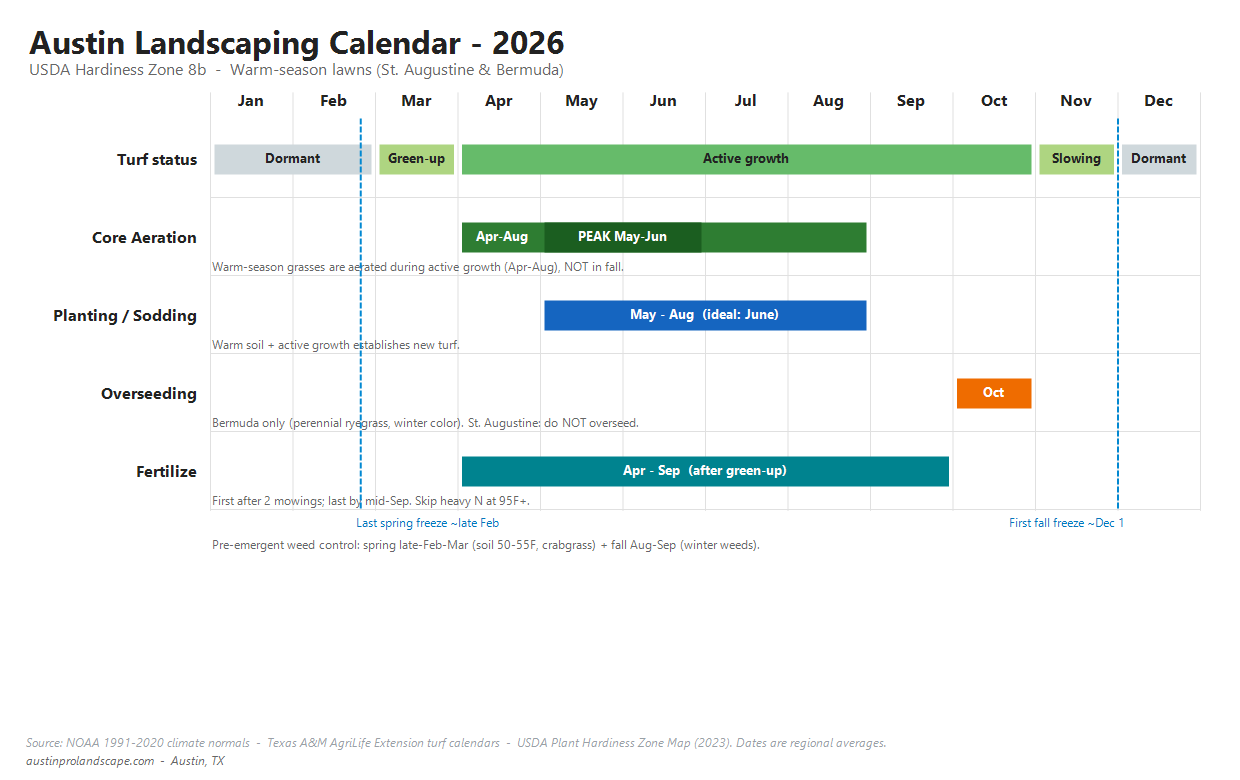
- Core aeration is done in late spring through summer (April–August), during active growth — NOT in fall.
- Overseeding: St. Augustine cannot be overseeded (no seed is sold); Bermuda can take an optional perennial-ryegrass overseed in October (soil ~72°F) for winter color. Austin lawns do not need the annual fall overseed that transition-zone fescue requires.
- Best time to plant or sod a warm-season lawn is late spring to summer (May–August), when soil is warm and the grass is actively growing.
What are Austin’s frost dates and hardiness zone?
Austin and Travis County sit in USDA hardiness zone 8b to 9a. NOAA 1991 to 2020 normals put the average last spring frost in late February, around Feb 23, and the first fall frost near Dec 1. That leaves a frost-free growing season of about 280 days. St. Augustine and Bermuda, both warm-season, are the primary lawn grasses.
| Fact | Value | Source |
|---|---|---|
| USDA hardiness zone | 8b–9a (Travis County; much of metro 8b, warm urban pockets 9a) | USDA Plant Hardiness Zone Map (2023) |
| Avg last spring frost | late February (~Feb 23 median) / safe planting by mid-March (90%) | NOAA 1991–2020 normals |
| Avg first fall frost | early December (~Dec 1) | NOAA 1991–2020 normals |
| Frost-free growing season | ~280 days | derived from NOAA normals |
| Primary lawn grasses | St. Augustine (typical/shaded lawns), Bermuda (full sun) — both warm-season | Texas A&M AgriLife |
| Cool-season note | Fescue and fall overseeding are not standard in Austin (warm-season region) | Texas A&M AgriLife |
What should I do for my Austin lawn each month?
Core aeration opens in April, peaks in May and closes as late as August. Planting or sodding works best May through August, with early June ideal for St. Augustine. The spring pre-emergent window opens in late February, and the final fertilizer goes down by early to mid September. From October on, skip fertilizer and start leaf cleanup.
A = Aeration · OS = Overseeding · P = Planting/Sodding. St. Aug height 2.5–4″, Bermuda 1–2″. Target ~1″ water/week in active season (observe current Austin Water watering stage/days).
| Month | Aeration window | Overseeding window | Planting / sodding | Key lawn-care tasks |
|---|---|---|---|---|
| Jan | — (dormant) | — | — (dormant) | Turf dormant/brown; mow only to top winter weeds; little/no watering; service & sharpen mower; soil test; plan. |
| Feb | — | — | — | Spring pre-emergent window opens late Feb (apply when soil hits 50–55°F for 4–5 days) for crabgrass/summer grassy weeds. Still mostly dormant. |
| Mar | — (wait for active growth) | — | — (too early) | Green-up begins (last frost ~late February; safe planting by mid-March). Resume weekly mowing once frost danger passes. Finish spring pre-emergent by mid-March. Hold nitrogen until fully greened + mowed twice. |
| Apr | Opens (Apr) — during active growth | — | Late-April start OK | First St. Augustine fertilizer after green-up + 2 mowings (late Apr). Begin dethatching with aeration. Mow weekly. |
| May | Peak (aerate + dethatch) | — | Good (warm soil) | St. Augustine first/early fertilizer; Bermuda wait to late May–June. Mow weekly; water ~1″/wk. |
| Jun | Continue | — | Ideal (early June best for St. Aug) | Bermuda first fertilizer (late May–June, after green-up + 2 mows). Fertilize 0.5–1 lb N/1,000 sq ft. Mow weekly (Bermuda every 5–7 days). |
| Jul | Can continue | — | OK with irrigation | Summer fertilization (St. Aug late June/early July; Bermuda every 4–8 wks). Avoid heavy nitrogen once temps hit 95°F+. Deep, infrequent watering. |
| Aug | Closes (as late as Aug) | — | OK with irrigation | St. Augustine mid-August feeding. Fall pre-emergent window opens mid-Aug–mid-Sept (soil ~70°F) for winter weeds. Avoid fertilizing drought-stressed turf. |
| Sep | Tail end | — | Late (prefer spring) | Final fertilizer by early–mid September (≥6 weeks before first frost). Fall pre-emergent for winter weeds. Large-patch fungicide as temps drop to ~80°F. |
| Oct | — | Bermuda only — optional ryegrass (~Oct, soil 72°F) for winter color; St. Augustine: do not overseed | — (too late for warm-season establishment) | Final mows of the season; no more fertilizer; finish fall pre-emergent; begin leaf cleanup. |
| Nov | — | — | — | Growth slows as nights cool; first fall frost not until ~early December. Reduce mowing & watering; begin leaf cleanup. No fertilizer. |
| Dec | — | — | — | First fall frost ~early December → dormancy onset; fully dormant, mow only to top weeds. Winterize irrigation (~40°F). Minimal/no watering; plan next season. |
Why is Austin’s lawn calendar different from cooler climates?
Austin grows warm-season St. Augustine and Bermuda, so core aeration happens April through August during active growth, not in fall like cool-season fescue. There’s no annual fall overseed either. St. Augustine has no commercially sold seed, and a ryegrass overseed on Bermuda in October is optional winter color. Mow St. Augustine at 2.5 to 4 inches.
- Aeration is a growing-season task here. Warm-season St. Augustine and Bermuda are core-aerated April–August while actively growing — the opposite of cool-season fescue lawns (aerated in fall). Aerating a warm-season lawn in fall, as it heads into dormancy, can damage it.
- No annual fall overseed. Transition-zone fescue must be overseeded every fall to stay thick; Austin’s warm-season lawns do not. St. Augustine has no commercially sold seed (it’s installed as sod/plugs), and Bermuda overseeding with ryegrass is an optional, cosmetic winter-color choice (October), not a maintenance requirement.
- St. Augustine vs Bermuda: St. Augustine = typical/shade-tolerant Austin lawns, mowed 2.5–4″; Bermuda = full-sun, heat/traffic-tough, mowed 1–2″, the only one of the two you’d overseed.
- Watering: target ~1″/week in the active season, but Austin Water enforces seasonal watering-day/stage restrictions — check the current stage before setting a schedule (see the Austin watering-rules guide).
Methodology & sources
This calendar compiles public, authoritative data for Austin/Travis County, TX — it is an original per-city compilation, not a reproduction of any single source:
- Frost dates & growing season: NOAA 1991–2020 U.S. Climate Normals (via Almanac.com / Garden.org frost-date tools), 30% probability threshold.
- Hardiness zone: USDA Plant Hardiness Zone Map, 2023 revision.
- Turf maintenance timing: Texas A&M AgriLife Extension — *St. Augustinegrass Home Lawn Maintenance Calendar* and *Bermudagrass Home Lawn Management Calendar* (warm-season schedules: aeration in active growth, post-green-up fertilization, spring/fall pre-emergent timing, ryegrass overseed guidance).
- Dates are regional averages; adjust to the current year’s weather and your lawn’s grass type and sun exposure.
Austin Lawn Care Calendar FAQ
When is the best time to plant grass in Austin?
In Austin, the best time to plant or sod warm-season grass is late spring through summer (about May through August), once soil is reliably warm and the grass is actively growing – St. Augustine and Zoysia go in as sod, Bermuda as seed or sod. Wait until after the average last freeze in late February, ideally mid-March, before planting frost-tender material. Austin lawns are warm-season only, so there is no fall fescue overseed, and fall is too late to establish new warm-season turf before dormancy.
How do you care for an Austin lawn in summer?
Austin’s brutal summer is about survival: mow high (St. Augustine 3.5-4 inches) to shade the soil, water deeply but infrequently within Austin Water’s restrictions, and do not fertilize drought-stressed turf. Water early morning on your assigned day, watch for chinch bugs in hot dry St. Augustine, and let the grass go a little dormant in a heat wave rather than overwatering. Warm-season grass is built for the heat if you do not scalp or starve it.
When should you aerate your lawn in Austin?
Aerate Austin’s warm-season lawns in late spring through summer (April-August) during active growth, when the grass recovers fast – the opposite of cool-season lawns that aerate in fall. Core aeration relieves compaction in Blackland clay and helps water and nutrients reach roots. On thin caliche soils, building organic matter matters more than aerating. Avoid aerating dormant winter turf.
When should you fertilize an Austin lawn?
Fertilize Austin warm-season lawns after spring green-up (around April, once the grass is growing and mowed a couple of times) and give a last feeding by September before dormancy. Avoid fertilizing in the heat of a drought-stressed summer or during winter dormancy. Base rates on a soil test – Austin’s alkaline soils often need iron for green-up more than extra nitrogen.
Do Austin lawns go dormant in winter?
Yes. Austin’s warm-season grasses (St. Augustine, Bermuda, Zoysia, buffalograss) go dormant and turn brown after the first hard freezes, usually staying tan from around December until spring green-up. That dormancy is normal, not death – the lawn greens back up as soil warms. With a ~280-day growing season and an average first freeze around early December, Austin’s dormancy is short compared with northern lawns.