
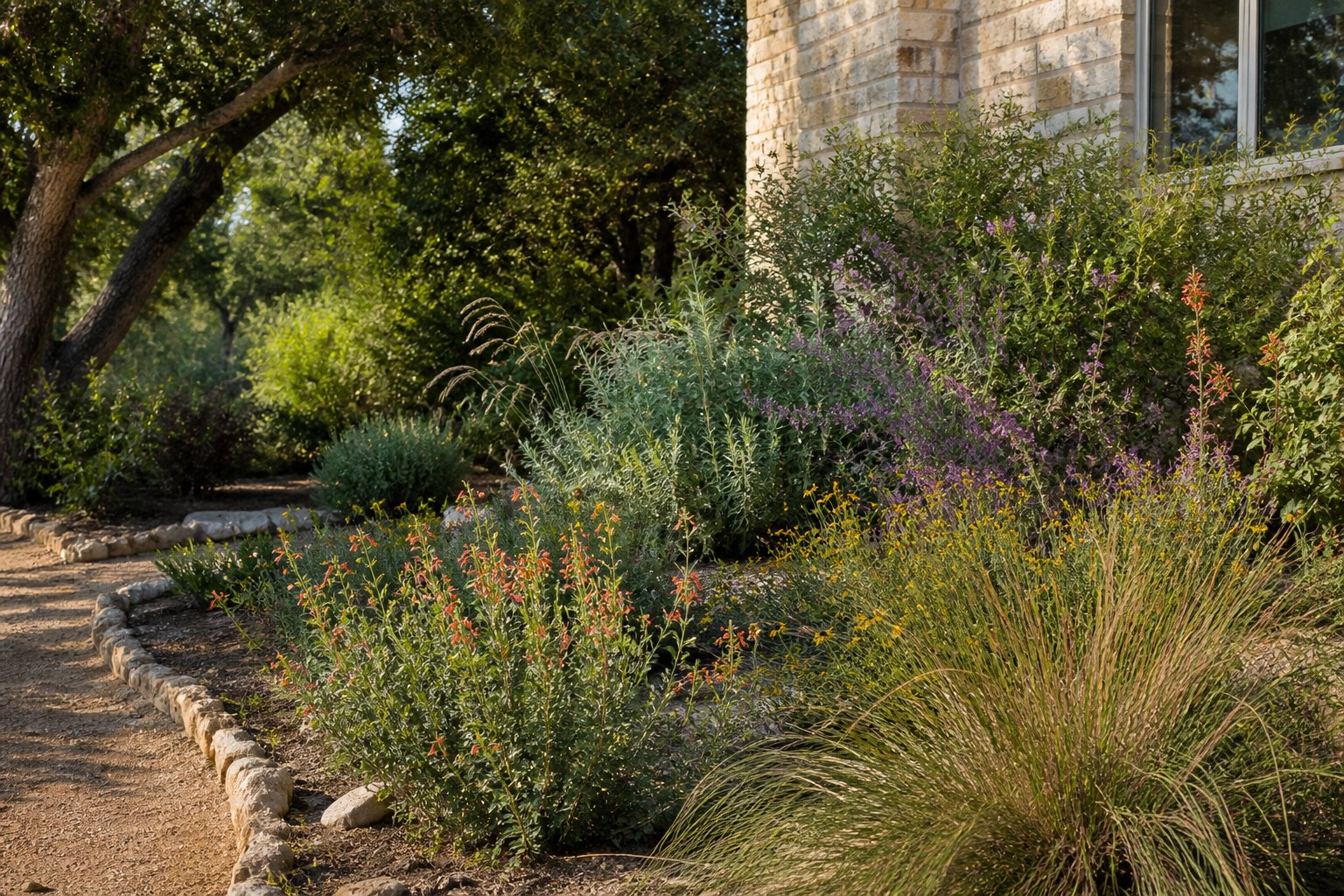
An Austin native-plant list is only useful after the yard has been divided into conditions. A west-facing strip beside limestone is not the same planting site as the soil below a live oak, even when the two beds are twenty feet apart. Start with hours of direct sun, how long the soil stays wet after rain, usable soil depth, and the plant’s mature width. Then choose from the shortlist below.
The mistake is choosing a plant before reading the bed
The City of Austin’s Grow Green plant guide gives sunlight, water, height, spread, and character notes for individual plants. Its separate landscaping guidance tells residents to evaluate sunlight, slope, drainage, soil depth, and soil type before selecting plants. That sequence matters. “Native” describes origin; it does not mean every native will tolerate every Austin microclimate.
Observe the proposed bed at roughly 9 a.m., noon, and late afternoon. Direct afternoon sun reflected from masonry is a different exposure from filtered light through an oak canopy. After a soaking rain, check the bed again the same day and the following morning. A pocket that remains saturated should not receive a plant whose City profile calls for dry or well-drained soil. For rocky lots, probe several locations rather than assuming the soil depth is uniform.
Nine candidates, with the disqualifiers left in
| Plant | Useful starting condition | Published mature size | Reason to reject it from a bed |
|---|---|---|---|
| Blackfoot daisy | Full sun; very low water | 6-12 inches high; 1-1.5 feet wide | The City says it requires dry conditions and can be temperamental to transplant. Do not put it in a low, wet pocket. |
| Flame acanthus | Sun to part shade; very low water | 3-5 feet high; 3-4 feet wide | It can reseed aggressively, so it is a poor fit where volunteer seedlings would be unwelcome. |
| Agarita | Sun to part shade; very low water | 3-7 feet high; 3-6 feet wide | Prickly foliage makes it unsuitable beside a narrow pedestrian route. |
| Texas sage | Full sun; low water | 5-8 feet high; 4-5 feet wide | It needs well-drained soil. The City’s profile also says not to shear it into a hedge. |
| Turk’s cap | Sun to part shade; low water | 2-6 feet high; 3-5 feet wide | It spreads into colonies, which can conflict with a tightly bounded formal bed. |
| American beautyberry | Shade; low water | 4-6 feet high; about 6 feet wide | It performs best with deeper soil and dependable moisture and is not identified as a rain-garden plant. |
| Inland sea oats | Shade; medium water | 2-4 feet high; 3-6 feet or more wide | It reseeds and can cover ground; skip it where that movement would be a maintenance problem. |
| Gulf muhly | Sun to part shade; medium water | About 2.5 feet high; 2 feet wide | It is not the lowest-water choice in this group, so do not treat it like a desert-edge plant. |
| Texas redbud | Sun to part shade; low water | 15-20 feet high; 10-15 feet wide | It needs well-drained soil and enough overhead and lateral room for a small tree. The City distinguishes it from Eastern redbud. |
The dimensions are not nursery-pot sizes. They are the published mature ranges that should drive spacing. A one-gallon shrub may look lonely on installation day and still be the correct choice if its adult spread fills the allocated space.
Three Austin beds need three different shortlists
Below a live oak, where shade and root competition arrive together
For a protected understory with usable soil, start the comparison with Turk’s cap, American beautyberry, and inland sea oats. They are not equivalent. Beautyberry needs room for an approximately six-foot spread and benefits from dependable moisture. Inland sea oats can reseed into a wider stand. Turk’s cap can form colonies. A small bed that must keep a crisp edge may be better served by one well-placed shrub than by a grass that is allowed to move.
Do not solve canopy competition by burying the tree’s root flare or piling mulch against the trunk. Work around major roots, avoid an automatic assumption that “shade” means wet soil, and connect the plant decision to the site’s actual profile. The site’s Austin soil guide explains why shallow limestone-influenced ground and heavier clay pockets should not be treated as the same planting medium.
At a west-facing wall, reflected heat narrows the field
A dry strip that receives hard afternoon sun is the place to compare Texas sage, agarita, flame acanthus, and blackfoot daisy. Size separates them quickly. Blackfoot daisy occupies the front edge; Texas sage is a large shrub; agarita can become both tall and wide; flame acanthus sits between those scales. Pedestrian circulation then removes agarita from some locations, while wet soil removes blackfoot daisy and Texas sage from others.
This is also where mature form should win over routine shearing. A Texas sage planted in a four-foot opening is already at the lower edge of its published mature width. Selecting a smaller species is more coherent than repeatedly cutting a large shrub into a shape its City profile specifically discourages.
In clay that stays wet after a storm, fix the condition first
“Low water” is not permission to install a dry-ground plant into poorly drained clay. If the bed remains wet well after surrounding ground has drained, rule out blackfoot daisy and treat the well-drained-soil requirement for Texas sage and Texas redbud as a real constraint. Determine whether runoff, a downspout, grading, compaction, or a shallow impermeable layer is causing the persistence.
A rain garden is a separate design problem: plants must tolerate the site’s wet-and-dry cycle, and overflow must have a safe route. The City publishes a dedicated rain-garden plant category in Grow Green. Do not create one simply by digging a depression next to a foundation.
Deer pressure changes establishment, not the plant label
Austin’s current Grow Green guide deliberately removed the older deer-resistance ratings because the City found little consensus among lists. Its guidance says that young woody plants should be protected until they grow above the browse line. It also notes that aromatic, prickly, fuzzy, or fibrous plants may be less attractive to deer, but that does not make any selection deer-proof.
That correction changes how a shortlist should be read. Agarita’s prickly leaves may influence browsing, yet the same trait can make it the wrong plant beside a walk. A cage or other establishment protection can be a better response than choosing an oversized thorny shrub for a space that cannot hold it. Browse behavior also changes with food availability, so a neighbor’s untouched plant is not a guarantee for the next yard.
Spacing math is the cheapest design test
Measure the usable bed after subtracting gates, utility equipment, paths, and required access. Then compare that number with mature spread. Two plants published at six feet wide do not belong side by side in an eight-foot bed unless the design explicitly accepts overlap and the resulting maintenance. Conversely, placing one-foot-wide plants six feet apart creates years of exposed mulch and invites fillers that may later crowd the permanent layer.
Height belongs in the same calculation. Keep plants from blocking windows, address numbers, sightlines, and equipment clearances. A Texas redbud is a small tree, not a shrub substitute. A flame acanthus may reach five feet. Reading the upper end of the published range before purchase prevents a nursery cart from becoming a pruning obligation.
The Austin Water rebate adds a separate timing gate
Customers considering Austin Water’s WaterWise Landscape Rebate should use the program’s current rules rather than assuming every landscape purchase qualifies. The City’s rebate FAQ says participants must wait for approval before beginning work and identifies spring and fall planting windows. It describes fall as ideal for trees, shrubs, cacti, succulents, and many perennials, while spring is identified for flowering perennials.
Those are program conditions, not a blanket citywide prohibition on planting outside the windows. For scheduling beyond the rebate, use the Austin seasonal planting guide and the requirements of the actual plant. If converting a lawn area, compare the operational tradeoffs in the site’s xeriscape-versus-lawn analysis before selecting individual plants. For a full lawn-to-native conversion, see our xeriscaping in Austin service.
A nursery sequence that prevents expensive mismatches
- Map exposure: mark direct sun by time of day, including reflected heat.
- Read water movement: revisit the bed after meaningful rain and identify runoff and persistent wet spots.
- Probe soil depth: check several points for rock, fill, compaction, and major roots.
- Reserve mature space: use the upper end of the published height and spread when clearances matter.
- Decide what movement is acceptable: reseeding and colony formation can be useful in a naturalized bed and frustrating in a formal edge.
- Check household constraints: verify current toxicity information when children or pets may contact or ingest plant parts.
- Locate utilities: use Texas 811 before digging and keep required access to meters and service equipment.
If the conditions do not point clearly to a plant, the next step is not a longer shopping list. It is a better site reading. A site-specific landscape design should resolve drainage, circulation, mature scale, and maintenance expectations before species are finalized.
Four questions to settle before checkout
Does every plant in Austin’s Grow Green guide count as a Texas native?
No. Grow Green includes native and adapted plants. This article’s shortlist uses entries identified as native in the City’s individual profiles, but buyers should still confirm the exact botanical name on the nursery label.
Which native is the default choice for dry Austin sun?
There is no single default. Blackfoot daisy is a low dry-edge plant; Texas sage and agarita are large shrubs; flame acanthus is a spreading, reseeding shrub. Mature size and drainage choose among them.
What belongs under an established live oak?
Turk’s cap, American beautyberry, and inland sea oats are reasonable comparisons for shade, but soil moisture, root competition, available width, and tolerance for spreading still decide the placement.
Can the shortlist identify a deer-proof plant?
No. The City removed deer-resistance ratings from its guide because lists lacked consensus. Protect young woody plants and treat unpalatable traits as possible deterrents, not guarantees.
Sources behind this Austin shortlist
- City of Austin Grow Green searchable plant guide
- City of Austin Native and Adapted Landscape Plants guide
- City of Austin landscaping and site-evaluation guidance
- Austin Water WaterWise Landscape Rebate FAQ